
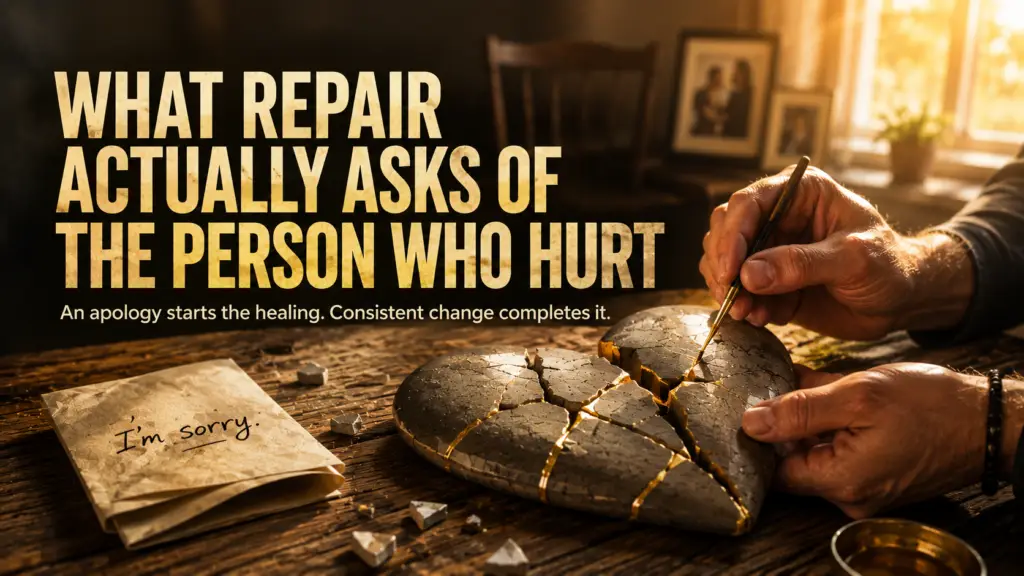
The specific demands that go beyond saying the right words.
“Forgiveness is the fragrance the violet sheds on the heel that has crushed it.”
— Mark Twain
When something has gone wrong in a relationship and repair is needed, most of the cultural attention falls on the hurt party — what they need, how they should respond, whether they will forgive, how long it should take. Less attention falls on what is actually required of the person who caused the harm, beyond the basic expectation that they apologize. But the demands on the person who hurt are extensive, often more demanding than the apologies they offer suggest, and the relationships that actually repair are usually the ones where the person who caused harm met these demands fully rather than treating the apology as the full extent of their work.
Understanding what repair actually asks of you, when you are the one who has hurt someone, is essential for being effective at the repair work that close relationships will inevitably require. The work is not just to say the right words. The work is to take on the longer, more sustained effort that genuine repair requires, much of which happens after the apology has been delivered. This effort is part of what distinguishes the relationships that move forward after harm from the ones that get stuck repeating the same patterns.
The Demand of Sitting With Discomfort
The first demand of repair is that you sit with the discomfort of having caused harm without trying to escape it through reflexive apologies, justifications, or premature requests for forgiveness. This discomfort is significant. It includes the shame of having behaved poorly, the exposure of being seen at your worst by someone you care about, the guilt of knowing you have caused real harm to someone real. The reflex is to relieve this discomfort as quickly as possible by saying “sorry” and moving on. The demand of repair is to stay in the discomfort long enough to actually engage with what you did and what it cost.
This sitting is often more uncomfortable than the original harm felt. The harm was usually done in a moment of activation, with limited awareness of impact. The repair requires full awareness, sustained attention, and acceptance of the difficulty without immediate relief. Many people retreat from this demand by escalating the conflict, dismissing the seriousness of what they did, or rushing toward apology and forgiveness so that they do not have to stay with the harder feelings. The relationships that repair are usually the ones where the person who caused harm could tolerate the discomfort rather than escape it, even when the tolerance felt like more than they could manage.
The Demand of Holding Without Defending
A second demand of repair is being able to hear what the hurt party shares about their experience without defending yourself against it. They may describe the harm in ways that feel exaggerated to you, in language that feels accusatory, with a level of distress that feels disproportionate to what you intended. The reflex is to push back, to clarify, to insist that the description is unfair, to explain what you actually meant. The demand of repair is to hold space for their experience as they describe it, even when their description differs from your sense of what happened.
This is not because their description must be accepted as the final truth — there may be subsequent conversations where your perspective gets shared. But during the repair, your job is to hear their experience without contesting it, to take in what was real for them, to demonstrate that you can hold their reality without immediately defending your own. This demand requires substantial emotional regulation and the ability to delay your own need to be understood until the hurt party has been heard. People who can do this consistently are usually the ones whose repairs land most effectively, because their willingness to hear without defending is itself part of what the relationship needed.
The Demand of Sustained Change
The third and longest demand of repair is the sustained change that the apology committed to. The hurt party is watching, often without consciously knowing they are watching, to see whether the behavior that produced the harm actually shifts in the days and weeks and months after the apology. If it does, the apology gets completed by the behavior, and the trust that was broken gets gradually rebuilt. If it does not, the apology dissolves into evidence that the words were not connected to anything real, and the trust does not recover regardless of how many times the apology was repeated.
This demand is the most difficult because it persists beyond the moment of the conversation. The apology took an hour. The change required to honor it may take years. There will be moments when the old behavior shows up again, and how you handle those moments determines whether the repair holds. The relationships that recover most completely from harm are usually the ones where the person who caused it accepted that the apology was the beginning of the work rather than the end of it, and put in the sustained effort of actual behavioral change over the extended period that change actually requires. This is hard work, but it is the work that distinguishes repair that lasts from repair that fades.
💡 Key Takeaway
Repair asks more of the person who hurt than the apology itself — it asks for the capacity to sit with the discomfort of having caused harm without escaping it through reflexive apology, the ability to hear the hurt party’s experience without defending against it, and the sustained change that completes the apology with actual behavioral difference over time. The apology is the opening of the repair work, not the end of it. The relationships that recover most completely from harm are usually the ones where the person who caused it accepted that the work would extend beyond the conversation and put in the sustained effort that genuine repair actually requires.