
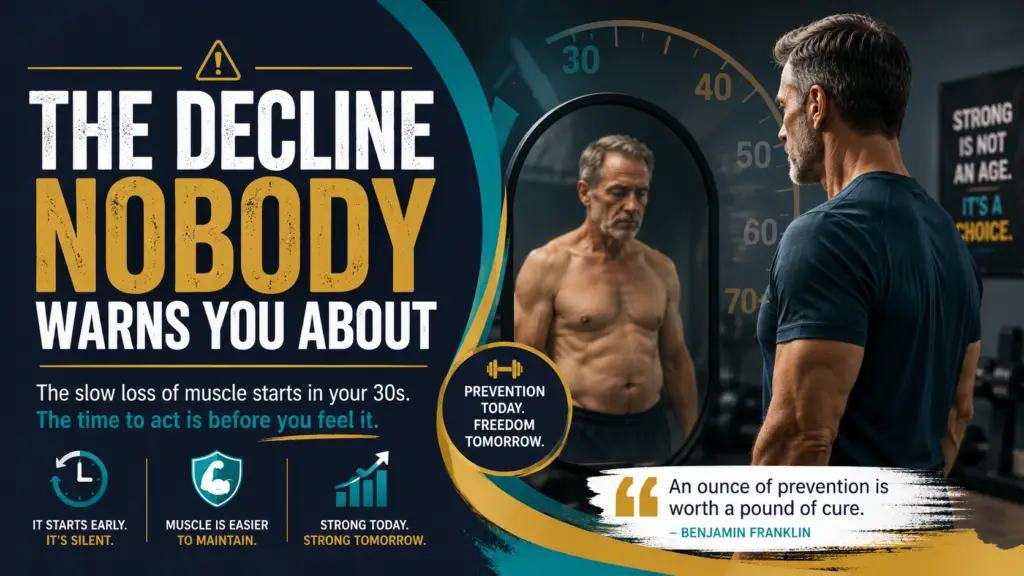

Why the slow loss of muscle goes unmentioned until it has already done its damage.
“An ounce of prevention is worth a pound of cure.”
— Benjamin Franklin
There are some changes that come with age that everyone seems to talk about. Gray hair, reading glasses, the slowing of metabolism, the aches that accumulate. But there is one change that unfolds in nearly everyone, that profoundly shapes how the later decades of life go, and that almost nobody warns you about in advance: the slow, steady loss of muscle and strength that begins in your thirties and continues, quietly, for the rest of your life unless something is done to stop it. It is a decline that arrives without fanfare, produces no obvious symptom for years, and is rarely mentioned in the ordinary conversations people have about getting older.
This silence is costly, because the loss of muscle is one of the most consequential and most reversible changes the aging body undergoes. The fact that it goes unmentioned means that most people first encounter it not as a piece of useful information they can act on, but as a fait accompli, a frailty that seems to appear from nowhere in later life when the accumulated losses finally become impossible to ignore. By then, the easy window for intervention has narrowed considerably. Understanding why this decline goes unwarned, and choosing to take it seriously before it announces itself, is one of the more valuable things a person can do for their future physical self.
Why the Warning Never Comes
The loss of muscle goes unmentioned for several intertwined reasons, the first being that it produces no symptom anyone notices. There is no pain, no visible change for years, no moment that prompts concern or a doctor’s appointment. The process is so gradual and so silent that it generates none of the signals that would ordinarily bring a health issue to attention. Because daily life requires only a fraction of a person’s strength, the decline can advance considerably while everything still feels fine, and a problem that feels like nothing rarely becomes the subject of warning or advice. The body simply does not raise an alarm about a loss that is not yet interfering with anything obvious.
A second reason is that the gradual loss of strength is so widely shared that it has come to seem normal rather than addressable. When nearly everyone experiences the same slow decline, it gets absorbed into the general expectation of what aging is, treated as an unavoidable feature of getting older rather than as a specific process that can be slowed or reversed. This framing discourages warning because there seems to be nothing to warn about; it is just what happens. The combination of producing no symptoms and being universally expected means the decline slips past the kind of attention that would otherwise prompt people to mention it, and so it advances in silence across entire populations.
What the Silence Costs
The cost of this silence is that people lose the chance to act during the years when action would be easiest and most effective. Muscle is far easier to maintain than to rebuild, and far easier to rebuild from a modest loss than from a severe one. The decades during which the decline is quietly underway are precisely the decades during which a modest, sustained effort could preserve enormous amounts of strength and function. Because no one warns of the decline, most people do nothing during this window, allowing the losses to accumulate unopposed until they reach the point where the consequences finally become visible and concerning.
By the time the losses become apparent, often as frailty, instability, or a frightening fall in later life, a great deal of ground has been ceded that could have been held. The person who first learns about muscle loss when they are already significantly weakened faces a harder and longer road back than the person who learned of it early and acted to prevent the worst of the decline. The silence, in other words, does not merely delay knowledge; it converts a manageable, preventable problem into a more serious one by ensuring that the easy years of intervention pass unused. This is why the lack of warning is not a trivial omission but a genuinely consequential gap.
Becoming Your Own Early Warning
Since the warning rarely comes from outside, the most useful response is to become your own early warning system, to learn about the decline and take it seriously before its effects force the issue. This means understanding that muscle loss begins far earlier than most people imagine, that it hides behind a daily life that demands little of your strength, and that the absence of any symptom is not evidence that nothing is happening. Armed with this understanding, you can choose to monitor your own functional strength, to notice the early signs as they appear, and to begin the modest, sustained effort that preserves muscle long before its loss becomes a crisis.
The great advantage of acting as your own early warning is that the intervention required is so achievable when started early. A person who understands the decline and begins challenging their muscles in their forties or fifties, while the losses are still modest, faces a far easier task than one who waits until frailty arrives. They are preserving strength rather than reclaiming it from a deep deficit, and they can do so with the kind of modest, consistent effort that fits into an ordinary life. The decline that nobody warns you about is, fortunately, one you can warn yourself about, and doing so in time is among the more powerful choices available for shaping how your later decades unfold.
💡 Key Takeaway
The slow loss of muscle and strength that begins in your thirties is one of the most consequential changes the aging body undergoes, yet almost nobody warns you about it, because it produces no symptoms for years and is so universally shared that it has come to seem like a normal, unavoidable feature of aging rather than an addressable process. This silence is costly, because it ensures that the easy window for intervention, the decades when modest sustained effort could preserve enormous strength, passes unused, converting a preventable problem into the frailty that seems to appear from nowhere in later life. Since the warning rarely comes from outside, the most valuable response is to become your own early warning, learning about the decline, taking the absence of symptoms as no reassurance, and beginning the achievable effort to preserve strength long before its loss becomes a crisis.